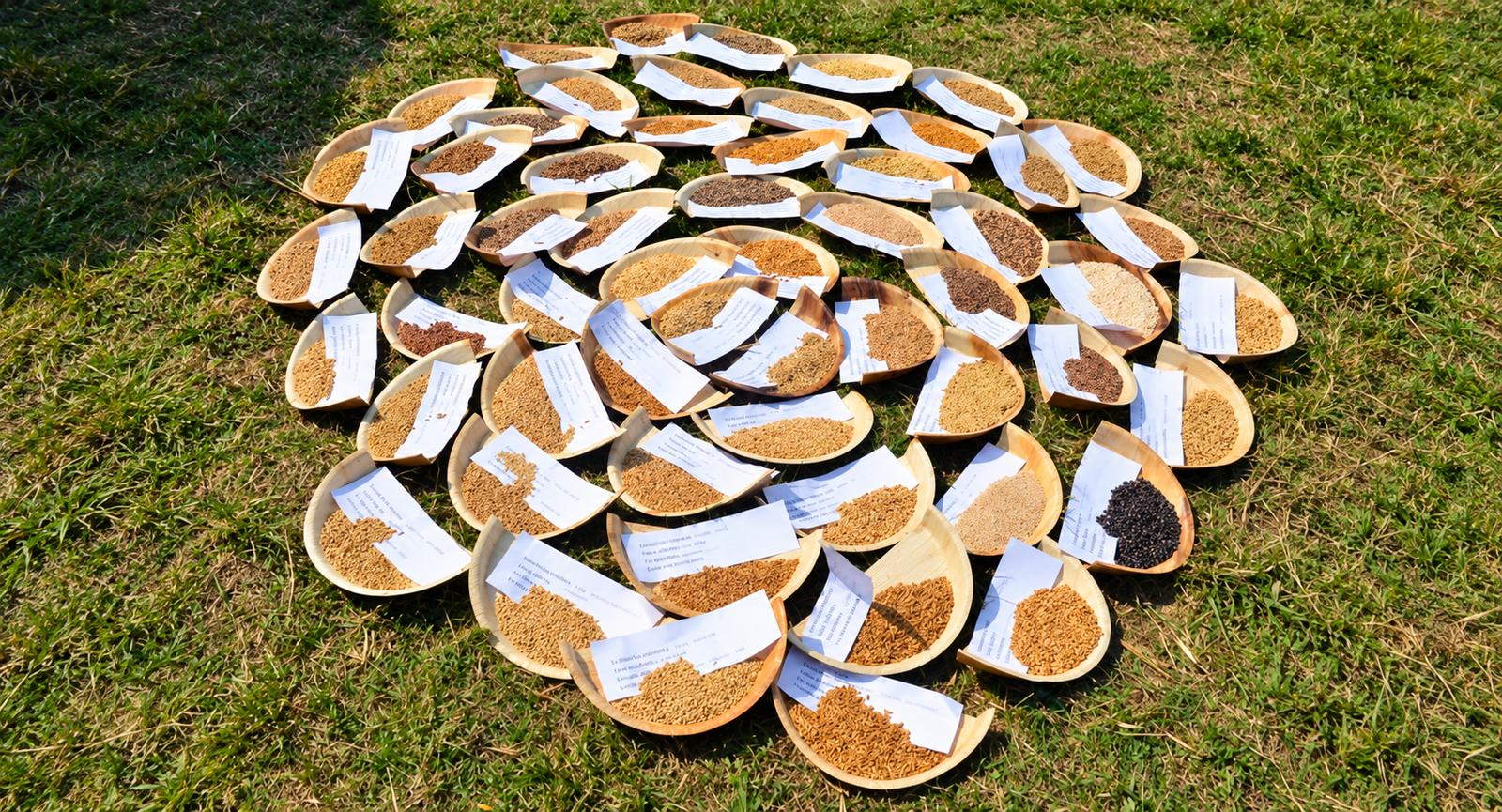
Sahkar Se Samridhi: India’s Answer to the Global Seed Monopoly
By Binod Anand
Across the developing world, a growing number of agricultural scholars now argue that the CGIAR system—once the torchbearer of the Green Revolution, has gradually transformed into an ecosystem shaped by transnational philanthropic-capital, private donors, and external policy networks. With rising dependence on a narrow group of international funders, many of whom carry ideological biases and geopolitical interests, CGIAR’s governance structure increasingly resembles a global influence bloc rather than a neutral scientific institution. This shift has triggered deep anxiety within biodiversity-rich nations like India, Ethiopia, Peru, and the Philippines. They fear that decision-making over germplasm, data, and research priorities is slowly drifting away from sovereign governments toward foreign-funded policy circles and external non-state actors whose objectives rarely align with national interests.
This concern intensified during the One-CGIAR centralization agenda, which consolidated multiple autonomous centers into a single governance body. Critics observe that such restructuring could make it easier for powerful donors and external ideological groups to exert disproportionate influence over genetic resources originally collected from farmers of the Global South. The emerging picture is not of a traditional “deep state” but of a globally networked research-finance nexus—a space where private philanthropy, corporate seed interests, and Western policy institutions converge to shape agricultural futures without adequate representation of countries whose germplasm built these gene banks in the first place.
The story of our age, however, is not written in data centers or artificial intelligence. It is written in seeds—tiny, fragile carriers of civilizational memory. Yet the farmer who nurtured these seeds for centuries now stands outside a global industry worth billion. The grains his ancestors preserved for monsoons, droughts, and harsh winds lie locked behind international treaties, foreign research networks, and corporate IP regimes. For millions across rural Asia, Africa, and Latin America, the heartbreak begins here: the original custodian of biodiversity has been reduced to a dependent customer.
When the International Treaty on Plant Genetic Resources for Food and Agriculture (ITPGRFA) was created, it promised solidarity and equitable benefit-sharing. But in practice, it has facilitated the upward flow of biological wealth—from the Global South’s fields to the Global North’s biotech laboratories. Technological and financial gains accrue to multinational giants that dominate genomics, trait mapping, and precision breeding. Critics now describe ITPGRFA as a “one-way extraction pipeline,” echoing colonial botanical expeditions that once moved germplasm from Indigenous communities into Western repositories.
The paradox is striking biodiversity lies in India, Ethiopia, Peru, Mexico, and Southeast Asia; but the world’s largest seed corporations are headquartered in the United States and Europe. Advanced breeding technologies flourished where industrial capital, early scientific infrastructure, and private equity investment converged. Meanwhile, biodiverse nations preserved genetic wealth but did not establish large indigenous seed corporations capable of monetizing it. They became custodians, not beneficiaries.
India refuses to accept this imbalance as destiny. Through the Biological Diversity Act (2002), India created a strong Access and Benefit-Sharing (ABS) framework under the National Biodiversity Authority (NBA). Any individual, corporation, or foreign entity seeking to use Indian biological resources must obtain approval and share benefits with local communities. NBA rulings require royalties, upfront payments, technology transfer, and community development funds—placing India among the world’s strongest guardians of biodiversity sovereignty.
India fortified this position after endorsing the Kunming–Montreal Global Biodiversity Framework, committing to regulate Digital Sequence Information (DSI), strengthen ABS enforcement, and ensure equitable benefit-sharing for all genetic resource utilization. This elevated India from a biodiversity-rich nation to a biodiversity-sovereign nation.
It is within this strategic landscape that Bharatiya Beej Sahakari Samiti Limited (BBSSL) emerges as a transformative response. Built on the ethos of Sahkar Se Samridhi, BBSSL envisions a cooperative-owned seed ecosystem capable of challenging multinational dominance. Instead of allowing germplasm to be absorbed into donor-driven research networks or corporate pipelines, BBSSL proposes a model where: Communities retain ownership of local germplasm; public scientists innovate through open, sovereign science;
cooperatives manage large-scale production and distribution; and profits return directly to rural households.
If Amul democratized dairy and IFFCO reshaped fertilizer access, BBSSL can democratize the seed economy. It could become the world’s first large, farmer-owned seed cooperative capable of standing toe-to-toe with multinational seed giants—offering not just competition, but a structural alternative to Western-dominated corporate seed cartels.
Around the world, seed geopolitics is intensifying. On one side stand multinational corporations, philanthropic-capitalist donor blocks, and increasingly centralized research networks. On the other stand nations fight to reclaim their biological heritage and farmers demand dignity over what they grow and eat. India’s cooperative seed revolution—grounded in sovereign law, constitutional values, and public science—may emerge as the template for countries like Mexico, Kenya, Ethiopia, Peru, and the Philippines.
In the end, one question defines this century: Who will control the future of food—the corporations that discovered profit in seeds, or the communities that nurtured them for millennia?
For the first time in decades, the Global South is refusing to stay silent.
Binod Anand is the Founder & Executive President of the World Cooperative Economic Forum (WCOOPEF) and Secretary General of the Confederation of NGOs of Rural India (CNRI). A cooperative economist and rural development strategist, he champions farmer-centric value chains, cooperative-led economic growth and India’s leadership in the global cooperative movement.


latest video


news via inbox
Nulla turp dis cursus. Integer liberos euismod pretium faucibua